As industries accelerate their Industry 4.0 and smart manufacturing initiatives, the ability to manage, mobilize, and operationalize data in real time has become non-negotiable. Modern manufacturing environments generate massive data volumes from sensors, PLCs, SCADA systems, MES, ERP platforms, and connected industrial equipment. Converting this fragmented, high-velocity data into actionable insights requires a modern, scalable, and intelligent operational data framework. This is precisely where Industrial DataOps plays a transformative role.
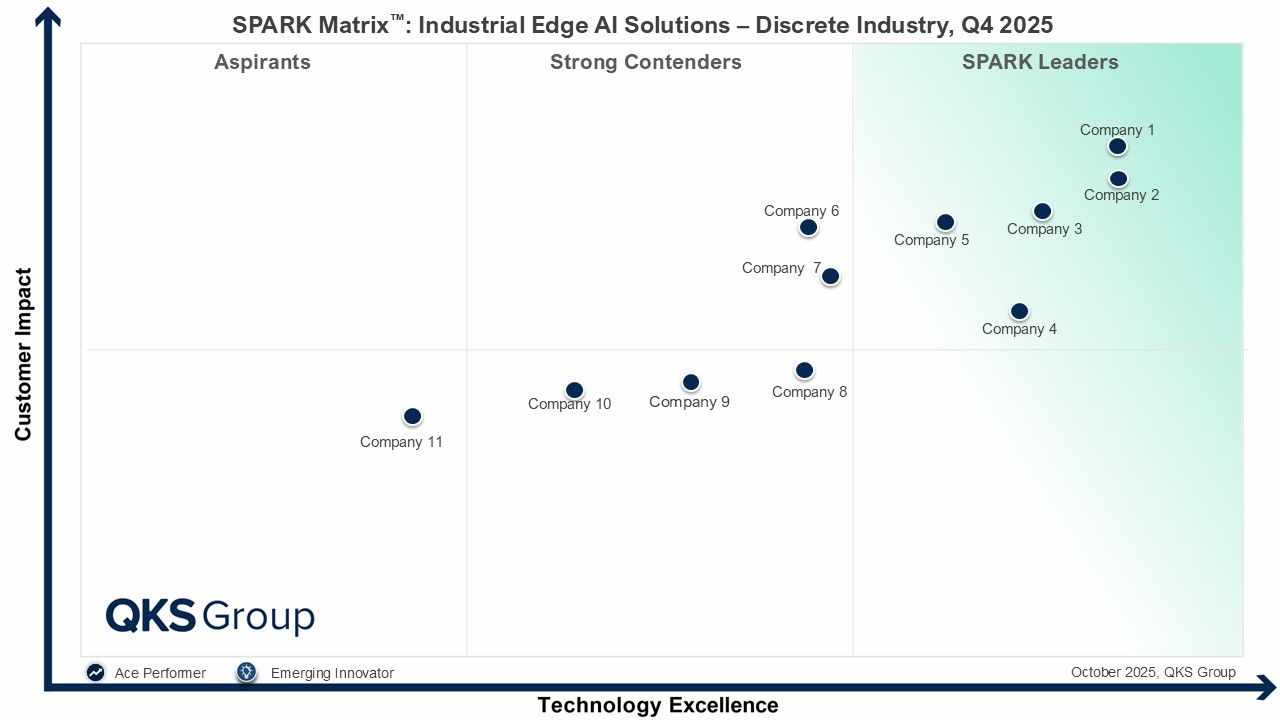
QKS Group’s SPARK Matrix™ reveals that organizations adopting Industrial DataOps are achieving substantial improvements in decision accuracy, operational visibility, predictive maintenance, and cost optimization. By establishing automated data pipelines, contextualizing OT and IT data, and enabling real-time analytics, Industrial DataOps empowers manufacturers to transition from reactive operations to intelligent, proactive decision-making.
Click Here For More Information: https://qksgroup.com/market-research/spark-matrix-industrial-dataops-q2-2025-8520
Understanding Industrial DataOps
Industrial DataOps is a comprehensive framework designed to unify, orchestrate, and optimize the flow of industrial data from edge to cloud. It ensures data is accessible, trusted, contextualized, and analytics-ready across engineering, operations, and business functions.
Key Capabilities of Industrial DataOps Platforms
1. Real-Time Data Integration & Pipeline Automation
Industrial DataOps platforms ingest and process data from diverse sources such as PLCs, IoT sensors, MES, CMMS, SCADA, historians, and ERP systems. Automated data pipelines ensure uninterrupted data flow.
2. IT–OT Convergence
One of the biggest value drivers: contextual fusion of OT signals with IT business processes, enabling unified visibility and cross-functional insight.
3. Data Contextualization & Modeling
The platform enriches raw machine data with meaning—such as equipment hierarchy, production context, asset relationships, and quality attributes.
4. Edge Processing & Low-Latency Analytics
For time-sensitive manufacturing environments, real-time analytics are executed near the data source, reducing latency and improving response actions.
5. Data Governance & Quality Assurance
Built-in governance frameworks ensure data lineage, data quality, metadata management, and secure operations across distributed industrial environments.
6. AI, Predictive Insights & Digital Twins
Advanced Industrial DataOps supports AI-led use cases such as predictive maintenance, anomaly detection, and real-time digital twins for manufacturing lines.
Together, these capabilities make Industrial DataOps a mission-critical foundation for smart factories.
Market Drivers Accelerating the Adoption of Industrial DataOps
1. Rise of Industry 4.0 & Smart Factories
Manufacturers are prioritizing operational intelligence, automation, and predictive insights. Industrial DataOps makes it possible by normalizing and orchestrating data from thousands of industrial assets.
2. Explosion of Sensor & Machine Data
With IoT adoption rising, manufacturers are overwhelmed with unstructured and streaming data. Industrial DataOps solves this scalability challenge.
3. Growing Need for Real-Time Decision-Making
From production optimization to quality assurance, organizations require real-time visibility—something traditional ERP or MES systems cannot deliver alone.
4. Demand for Predictive & Autonomous Operations
Predictive maintenance models and digital twins depend on high-quality, contextualized data—enabled only by modern Industrial DataOps architectures.
5. Compliance, Sustainability & Energy Efficiency Requirements
Accurate data is needed to meet global regulations, track environmental performance, and improve energy efficiency.
Download Sample Report Here: https://qksgroup.com/download-sample-form/spark-matrix-industrial-dataops-q2-2025-8520
Key Challenges Organizations Face When Evaluating Industrial DataOps Platforms
Despite rapid market growth, selecting the right platform remains complex.
1. Fragmented Industrial Ecosystems
Each plant operates differently with unique data structures, legacy systems, and proprietary protocols. Not all vendors support deep OT integration.
2. Scalability Across Multi-Site Manufacturing
Enterprises require cross-plant standardization—something many smaller or legacy vendors cannot provide.
3. Data Governance Across IT & OT Silos
Harmonizing governance policies across engineering, operations, and cloud teams is challenging without advanced DataOps capabilities.
4. Legacy Systems & Proprietary Industrial Protocols
Not all vendors can integrate deeply with legacy controllers, older MES systems, or non-standardized historian formats.
5. Lack of Real-World Benchmarking
Most analyst reports fail to capture performance metrics such as:
latency under heavy load
accuracy of contextual models
robustness of connectors
ease of integrating AI/ML
Enterprises want insights based on real deployments—not theoretical evaluations.
How SPARK Plus™ Bridges the Evaluation Gap
QKS Group’s SPARK Plus™ resolves these challenges with data-backed, dual-layer insights combining analyst research with verified customer intelligence.
1. Contextual, Industry-Specific Vendor Scoring
Organizations can filter performance by:
sector (automotive, pharma, oil & gas, electronics)
plant size
geographical region
use-case complexity
deployment architecture (on-premise, hybrid, cloud-edge)
This ensures highly relevant vendor selection.
2. Real-World Operational Performance Data
SPARK Plus™ gathers customer-validated benchmarks for:
connector reliability
integration speed
ease of scaling
contextual modeling accuracy
OT protocol support
AI model performance
These insights give enterprises confidence in real-world viability.
3. Transparent Evaluation Framework
Vendors are scored on:
real-time pipelines
IT–OT convergence
digital twin support
edge analytics
scalability
governance
AI readiness
security and compliance
This consistency empowers buyers to make evidence-based decisions.
4. Visibility for Emerging Innovators
The platform highlights smaller vendors with strong technical capabilities that often go unnoticed in traditional reports.
Strategic Impact of Adopting Industrial DataOps
1. Higher Operational Efficiency
Real-time data enables faster detection of inefficiencies, reducing bottlenecks and cycle times.
2. Predictive Performance & Reduced Downtime
AI models powered by contextualized data significantly improve maintenance planning and reduce unexpected failures.
3. Cross-Functional Collaboration
Unifying IT and OT data enhances cooperation across engineering, operations, and business teams.
4. Scalable Multi-Plant Intelligence
Standardized data models allow global manufacturers to replicate improvements across all facilities.
5. Accelerated Digital Transformation
Industrial DataOps serves as the backbone for Industry 4.0, digital twin strategies, and autonomous operations.
Become A Client: https://qksgroup.com/become-client
Conclusion
Industrial DataOps is now a foundational enabler of advanced manufacturing, delivering unified, real-time, and AI-ready data infrastructure that empowers operational excellence. As manufacturers embrace Industry 4.0, they require platforms that ensure reliable data pipelines, contextualization, predictive intelligence, and scalable deployment across global plants.
QKS Group’s SPARK Plus™ offers a unique market advantage by combining analyst intelligence with real-world user validation, helping manufacturers confidently select platforms that align with their digital roadmap. With transparency, contextual insights, and evidence-backed scoring, SPARK Plus™ accelerates the adoption of Industrial DataOps and supports long-term industrial innovation.






Write a comment ...